

Most Philippine Best credit cards are good for domestic use, yet they rarely offer more than 0.3% cashback and often add foreign transaction fees of roughly 1.85% on every overseas purchase.
What does a dream lifestyle look like to you? At Ethereal Dreams we think it involves choices: the ability to travel without hidden fees, to shop internationally without worrying about currency conversions and to build wealth by using tools that work harder for you.
Keep exploring smart money moves. Browse freely, no email or phone on our site.
 Best Co-Branded Credit Cards 2025 in ➡️
U.S. credit cards, on the other hand, act like gateways to better rewards and global acceptance.
This article takes you through why the difference matters and how you can move closer to your financial dreams.
The Filipino guide to global credit cards and a life beyond borders
In this Article:
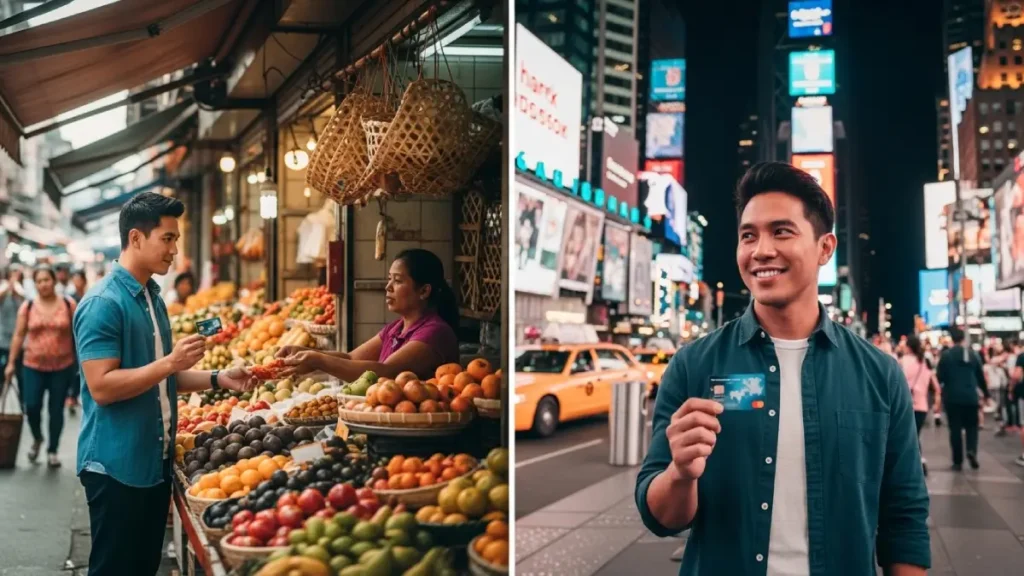
🔍 Understanding the Differences in Card Perks
Filipino banks have improved their offerings, but a quick comparison shows how far behind they remain compared with U.S. cards. Below is a quick reference table illustrating what you gain by looking abroad.
🔍 Quick Comparison – U.S. Cards vs Philippine Cards
| Advantage | U.S. Credit Cards | Typical Philippine Credit Cards |
|---|---|---|
| Cashback & Rewards | 1.5%–5% unlimited cashback on a wide range of spending categories. Some cards offer rotating 5% bonuses for grocery or travel purchases. | Frequently capped; base rates hover between 0.2% and 0.5%, with general retail spending yielding as low as 0.3% |
| Signup Incentives | New customers often receive US$200–US$750 in bonus value after meeting a spending requirement. | Welcome gifts are rare and typically consist of branded merchandise or small rebates. |
| Foreign Transaction Fees | Many issuers waive these fees altogether; those that do charge limit them to about 3%. | Cards usually add 1%–3.5% on top of the currency conversion. BPI, for instance, adds 0.85% plus a 1% Mastercard/Visa fee |
| Introductory Interest Rates | 0% APR on purchases for 12–21 months, giving cardholders time to pay off large expenses without interest. | No comparable interest holiday. Interest accrues as soon as the statement closes. |
| Travel and Purchase Protections | Includes trip cancellation insurance, baggage delay coverage and extended warranties. | Minimal protections; travellers often purchase separate insurance. |
| Integration with Global Fintech | Compatible with PayPal, Apple Pay, Google Pay and widely accepted by online merchants. | Limited or partial integration; linking to GCash or PayMaya may not always work. |
Quick Comparison – U.S. Cards vs Philippine Cards
These disparities stem from market dynamics. U.S. issuers compete aggressively for customers, while local banks operate in a smaller market with fewer incentives to innovate. As a result, U.S. cardholders enjoy features that still feel aspirational to many Filipinos.
Three Perspectives
Neutral View: The numbers reveal a clear gap. Higher rewards, lower fees and extensive protections can translate into tangible savings and convenience.
Critical Perspective: These perks come with strings attached: annual fees, strict eligibility and the danger of overspending to chase rewards. Not every U.S. card is fee-free; for example, some impose a 3% foreign conversion fee.
Strategic Takeaway: Consider your spending habits. If you primarily shop in the Philippines, your local card may suffice. If you travel, shop internationally or freelance for clients abroad, the added complexity of a U.S. card could pay off.
🧾 Can Filipinos Really Get a U.S. Credit Card?
You don’t need to be a U.S. citizen to hold a U.S. credit card, but you must tick a few boxes.
- Obtain an ITIN. Some banks allow applicants to use an Individual Taxpayer Identification Number instead of a Social Security Number. Capital One notes that those using an ITIN still need proof of income and a U.S. mailing addresscapitalone.com. This number is issued by the IRS and requires you to submit identification documents through Form W‑7.
- Secure a U.S. Address. Issuers will only mail cards domestically. A mail forwarding service can provide you with a U.S. address and forward your mail to the Philippinesmedium.com. Choose a reputable provider with transparent fees.
- Open a U.S. Bank Account. To settle your credit card bill, you need a way to transfer dollars. Many non-residents use fintech platforms like Wise and Relay, though these accounts lack FDIC insurance and require a U.S. addressllcuniversity.comllcuniversity.com. Mercury is stricter and now demands proof of residence in the U.S.
- Use a Friend’s Account as an Authorized User. If someone you trust already has a U.S. card, they can add you as an authorized user. Chase points out that authorized users can provide either a Social Security Number or ITIN and that the payment history may help you build creditchase.com. This route allows you to establish credit before applying on your own.
