

Dreams of self-driving vehicles have captivated human imagination for decades, appearing in science fiction and futurists’ predictions.
Today, that once-distant fantasy has materialized into tangible reality through Tesla’s groundbreaking autonomous delivery system.
Keep exploring smart money moves. Browse freely, no email or phone on our site.
 Tesla’s Dream-Driven Inventions in ➡️
What began as Elon Musk’s ambitious vision has culminated in the world’s first fully autonomous factory-to-home vehicle delivery – a Tesla driving itself from production line to customer driveway without human intervention.
This Tesla autonomous delivery milestone doesn’t just represent technological achievement; it fundamentally transforms how we buy cars, revolutionizes transportation logistics, and brings us into a future where vehicles can navigate our world independently.
Key Takeaways
- Tesla autonomous delivery system marks the world’s first fully autonomous factory-to-home vehicle delivery.
- The Tesla factory delivery system eliminates traditional transportation methods, allowing vehicles to deliver themselves.
- Tesla’s FSD technology combines vision systems, neural networks, onboard computers, and navigation integration.
- This breakthrough forces the automotive industry to accelerate self-driving tech, impacting supply chains and dealership networks.
- Factory-to-home autonomous delivery will likely become standard practice, reshaping customer expectations and experiences.
Navigate to What Matters
The Historic Milestone
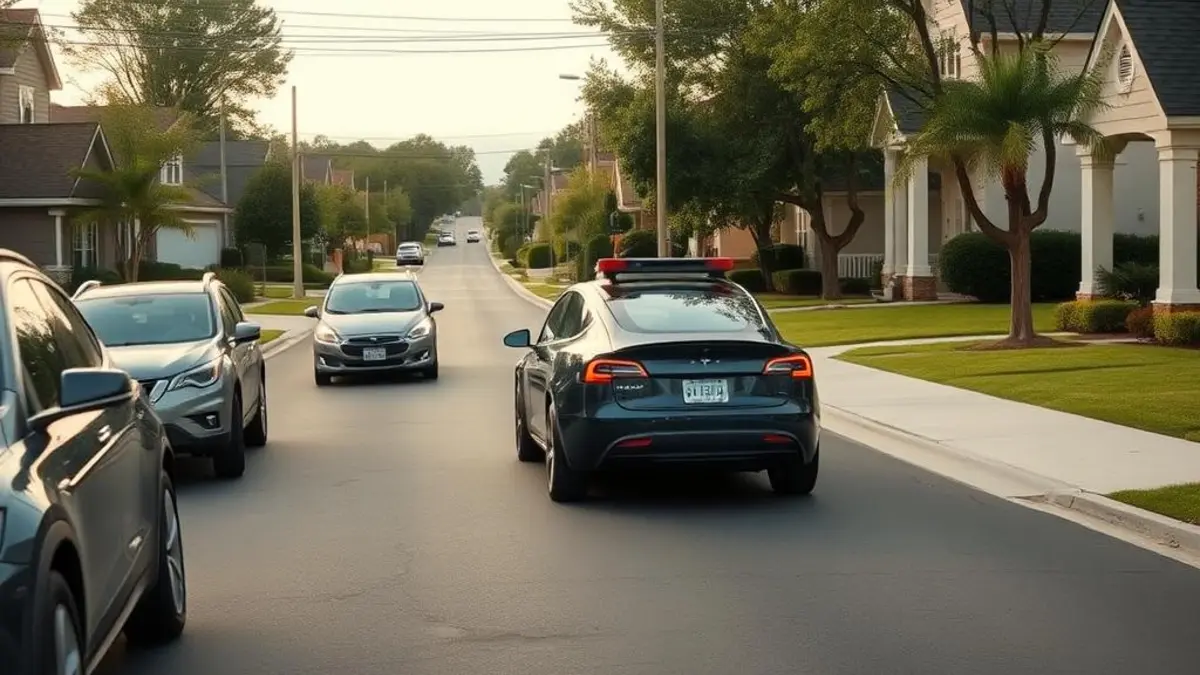
The first Tesla Model Y autonomous delivery marked a watershed moment in automotive history. This wasn’t merely a demonstration or controlled test – it represented a complete, real-world autonomous vehicle milestone:
- The vehicle navigated from Tesla’s factory through public roads.
- It handled complex traffic patterns, intersections, and highway driving.
- The car reached its destination and parked itself in the customer’s driveway.
- No remote operators or backup drivers were involved at any point.
This Tesla factory delivery system eliminated traditional transportation methods, with the vehicle essentially delivering itself. The Model Y traveled dozens of miles completely independently, showcasing the practical application of self-driving technology beyond passenger transportation.
Technology Behind the Breakthrough
The Tesla FSD technology powering this achievement combines several sophisticated components working in harmony:
- Vision System: Eight external cameras provide 360-degree visibility up to 250 meters away.
- Neural Networks: Advanced AI processes visual data to identify objects, predict movements, and make driving decisions.
- Onboard Computer: Tesla’s custom FSD chip processes enormous amounts of data in real-time.
- Navigation Integration: Detailed mapping and GPS systems plot optimal routes.
Unlike competitors relying on expensive lidar (laser-based detection), Tesla’s vision-based approach uses cameras as the primary sensors, supported by radar and ultrasonic capabilities.
This enables the self-driving car delivery system to recognize traffic signals, pedestrians, other vehicles, and road markings while making complex decisions in unpredictable environments.
The software continuously improves through Tesla’s vast data collection network, with millions of Tesla vehicles on the road feeding information back to refine the autonomous systems. [Sources]
“Tesla’s vision-based approach uses cameras as the primary sensors, supported by radar and ultrasonic capabilities.”
